
The Speaker’s Deck
On August 28, 1963, Martin Luther King Jr. delivered what became known as the “I Have a Dream” Speech in front of 250,000 people in Washington DC. Now, King’s words are known around the world. Many people don’t realize that the most striking part of that speech, recorded in history books, was unscripted.
After King had been speaking for 10 minutes, gospel singer Mahalia Jackson called out to him: “Tell them about the dream, Martin!” He set aside his prepared notes and began to speak the words which would quickly become familiar to people around the world.
Even though he was going off-script, this wasn’t pure improvisation. He was repeating a version of a speech he had given dozens of times over the previous year. The ‘dream’ Jackson prompted him to relay was actually a practiced rhetorical module.
Like King, inspiring leaders draw from a pre-existing deck of these modules: stories, metaphors, quotes, data points, personal anecdotes, etc. Like legos or playing cards in a deck, these modules are pieces that can be repeated, reshuffled, and rearranged. A speech may be unscripted, but the building blocks have been prepared long in advance.
One example of modular preparation, from the culinary world, is found in high-end restaurants: chefs often abide by the principle of “mise en place”: having all the tools and ingredients prepared and ready to go in advance of starting to cook. The constitutive pieces are ready to go in advance, there to be drawn upon at need, mixed and matched spontaneously. Public speaking requires a kind of rhetorical mise-en-place, with building blocks prepared that can be combined in any given moment.
This method isn't just for 'professional' speakers like politicians or activists. It matters for all leaders. Speaking well in the moment is about something deeper than performance. We want to be understood. We dread being boring, rambling, or (even worse) being revealed as having nothing much to say. We want to inspire and influence. Whether opening a staff meeting, responding to a donor’s question, or saying a few words at a town hall, these moments expose us. The ability to speak with clarity and authenticity determines whether our mission connects with others.
The best communicators are not those who have the most detailed notes, have every word scripted, or have a teleprompter or speech-writer. Most situations do not require comprehensive planning. In fact, a full script might make the speaker come across too stuffy or rigid. Instead, most contexts require the ability to respond with flexible eloquence. The best way to do this is by having a wide repertoire of ‘bits’ that can be summoned at will.
The spectrum of preparedness
We can think of preparedness as a spectrum. On the one hand, we can be underprepared. Without planning, we might ramble or repeat ourselves. disorganized and unclear. They’re not drawing from a deck at all, but from a ‘grab bag’ full of miscellaneous bits and pieces.
On the other side, we might radically overprepare, diligently spelling out each sentence in advance. This is, perhaps, the most common mistake, especially for people who are nervous or uncomfortable with speaking.
In the middle (as usual) is the sweet spot: prepared enough to be organized, but flexible enough to be fresh. People who master this, like MLK, have a prepared repertoire of cards they are able to draw upon at will.
What makes a good ‘module?’
Some good modules most leaders should have in their ‘deck’ include:
Autobiographical stories: Stories that drive us, form parts of our core identity. (E.g. Obama's story of his mother on the phone w/ insurance companies while dying of cancer.)
Metaphors: What are the most powerful ways of describing what you are doing? (e.g. Steve Jobs' "bicycle for the mind" analogy. Repeated and refined iteratively, he used this metaphor for computers over and over again.)
Organizational lore: origin stories, key events etc. (e.g. Steadman's encounter with scaling leadership development at the grassroots level in Uganda is a key point in our organizational history.)
Data points: important charts relevant to your work, key numbers or statistics. (A couple of such data points we think about often as Lead Beyond are the fact that the median age in Africa is 19 years, with the population of the continent estimated to reach 2.5 B [from current 1.5B] in 2050, approximately ¼ of the world’s population)
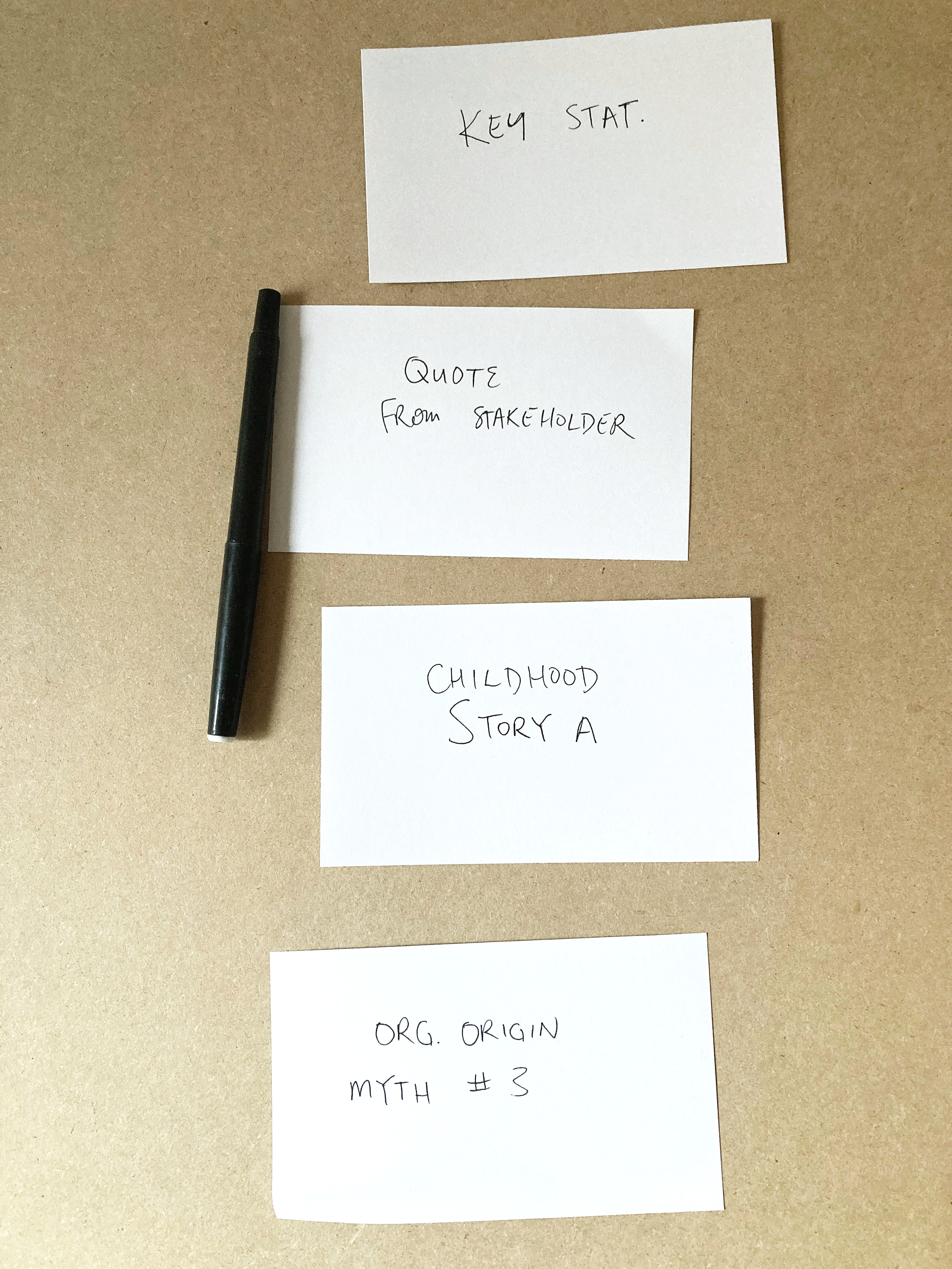
An example of different types of modules, how you might lay them out on notecards
How do you go about crafting these modules?
A few key steps might include:
Introspect: Are there stories, anecdotes, histories, pieces that you find yourself returning to repeatedly?
Record: Write these down. Maybe get a deck of notecards to write them on. Could be sticky notes, or even napkins. A journal works too, but obscures the idea that you want these to be ‘modular’ enough that you can remix them.
Test: Try them out in front of an audience. Which ones land, which ones fall flat? (Comedians do this with their jokes, testing them iteratively in front of people).
Refine: Rework after feedback from step 3.
Remix: Combine the modules. Try them in different orders, and in different contexts.
Add: other stories, personal reflections, anecdotes, etc.
The need for attention
Most of all, curating a speaker's deck requires us to be awake to the world around us; to notice our own experience in a way that we are often remarkably bad at. We often live through experiences without noticing their shape or meaning.
With practice, developing a deck of these modules that enhance one’s ability to speak in front of others in a way that balances preparedness with authenticity, and that ultimately incorporates others into the direction you are driving.
Building this repertoire takes time. We test stories that fall flat, refine metaphors that don't quite land, return to the same anecdotes until we grasp why they really matter. Gradually, we find ourselves reaching for the right module without thinking, speaking in ways that feel both prepared and spontaneous.
In the end, we aren't really just building a speaking technique. We’re learning to pay attention to your own experience, to find the patterns in what you've lived through, and to share those patterns with others in ways that help them make sense of their own work and life. The deck becomes a way of knowing yourself well enough to include others into a larger story.